Tuesday, February 28, 2017

February Favorites

1. Star Trek Trexels


This addictive mobile game is just what my Trekkie heart needed. Basically, you are an admiral in charge of staffing a Federation starship. You have to produce resources and spend them on away missions, training officers, and building rooms to make the ship function better. My favorite feature is the ability to add characters from the various Star Trek shows to your ship. My new goal in life is to recreate Voyager within this game. Plus, I play the role of an admiral. Help, I think I've died and gone to Star Trek Heaven.

2. Women and Entrepreneurship


I attended a lecture this month hosted by the Women's Services and Resources office at BYU. Jeanette Bennett, co-founder and editor of several Utah Valley magazines, spoke to us about how her experience as an educated mother drove her to start her own company. She gave us 11 tips on how to succeed and reach our dreams.

  • Be positive. See the good.
  • Be persistent. "Do the thing or bust!"
  • Be passionate. Lose track of time because you love the work you do.
  • Be excellent. Be hard to replace.
  • Be present wherever you are. Minimize distractions.
  • Don't take life too seriously.
  • Defy logic if it's right for you. Act on revelation.
  • Communicate with kindness.
  • Feed your soul.
  • Be you!
  • Trust the Lord.

I never wanted to start a business before, but now I'm giving it serious thought. This line of thinking brings me to my next favorite...

3. The Oregon Trail Card Game


I love games, clearly. Never have I been so close to winning without actually winning, and that distinction is what I love so much about this game! Gameplay is similar to the computer games of ancient yore, with a few exceptions. There are a few things I would have adapted differently from the original games, which only makes me seriously consider starting a game-making business.


4. Recent Changes to My Calling


Why is this unusual subject one of my February favorites? Because attending the training kind of lit of fire in my brain. I walked away with renewed motivation, clear purpose, and new ideas on how to be a better Temple and Family History missionary. That's right: one of the main changes in my stake is that my committee members are now labeled as missionaries, which is exactly what we are for the dead. I have so many ideas to spread the spirit of Elijah; I'll keep you updated on what works.

5. Asset Enrichment Service


A post showed up on my Facebook feed the other day and it directed me to a service opportunity I had never heard of. A few years ago, the Church put out a call for user submissions of writing, art, and photography. Now that they have received thousands of submissions, the Church needs help tagging these resources for people to easily find and use. Basically, you are given a photo with a title and description, and you get to suggest tags that may apply to the photo. It's incredibly easy and fast, but it's clearly a massive project. Crowdsourcing only works with a crowd, right?

Also, as I took the screenshot for this blog post, I couldn't help myself. I had to tag a few pictures before I returned to blogging. It's a little addicting.

6. Writing Excuses Podcast


Because I spend so much time listening to audiobooks, I rarely listen to podcasts. However, the Writing Excuses podcast is the one I return to again and again. The presenters are concise, funny, honest, and brilliant (though they claim to be "not that smart" at the beginning of every podcast). They give excellent advice and writing prompts. When I'm in a writing slump, I simply listen to a single episode of Writing Excuses, and it rekindles my passion for writing.

Monday, February 20, 2017

Sunday Thoughts: Verse

I was recently reading through selected writings of John Rosenberg, former dean of the College of Humanities at BYU, when I came across some interesting etymology. I give all credit to Dr. Rosenberg for pointing this information out.

The word "verse" comes from the Latin root "vertere," meaning "to turn or change direction." When we finish singing a verse of a song, we turn back to the beginning and start again.

This root can also be seen in words like "versus," when people turn against each other, and "reverse," when we turn back in the other direction.

Most importantly, this root can be seen in the word "convert," to turn with someone. In gospel terms, we are truly converted when we turn with Christ, away from the world and toward goodness, righteousness, and eternal life. We change directions, and as President Uchtdorf pointed out in "A Matter of a Few Degrees," we should be making course corrections daily. We should become converted daily. When we err, we should become converted immediately.

Turn with Christ. Isn't that beautiful? And we have a reminder of it every time we sing multiple verses of a hymn.

Good Arguments

I recently had the opportunity to judge a writing contest on campus. Students submitted their best persuasive papers, and I got to read and evaluate 11 of these arguments. I was amazed at the sophistication of both topic choices and writing styles, but I was most impressed by the rhetorical choices the writers made.

This experience got me thinking. We all need to make better rhetorical choices. In our era of instant distribution and charged emotions, it is easy to fire off an argument without thinking too much about who will read it and how they may respond. Through this writing contest, I got to read thoughtful arguments written by millennials, a generation often disparaged for being privileged with such technology and social media. My experience taught me that this generation is actually getting ready to take charge of the future in brilliant ways.

Lessons from millennial rhetoric, or ways to improve your own arguments:

1. Do not spray audience repellent.
To use another insect analogy, you catch more flies with honey. The challenge in arguing is that your audience initially disagrees with you. In some circumstances, they might even be referred to as "the enemy." But your goal in arguing is to remove that misnomer and replace it with "friend." Insulting your audience will not encourage them to believe you or agree with you or befriend you. Instead, identify with your audience and acknowledge their concerns as valid.

2. Appeal to your audience's emotions.
As logical as we like to think we are, we are highly emotional people, especially when trying to persuade each other. Use your word choice, tone, and personal experiences to steer the emotions in a direction favorable to your case. The best papers I read for this contest were structured around the extreme trials of the writers. They elicited my sympathy and, in a twist of logic, proved that they know what they're talking about. Don't underestimate emotions.

3. Serve your audience.
The most powerful argument that I read was basically trying to convince the audience that life will be okay after a loved one dies. This claim brings to mind the baptismal covenant to "mourn with those that mourn [and] comfort those that stand in need of comfort" (Mosiah 18:9). Above all, your argument should serve your audience. I think if you start with that motivation, the Spirit will guide you to say what needs to be said. Your rhetoric will be cleaner, kinder, and more effective. Don't make the audience be the servant; be the servant yourself.

Now, go out into the world and argue. We need arguments in order to discover both truth and Truth (doctrine). We need to know how to make a point without harming someone. We need arguments to collaborate, to get things done, to improve the world. So argue, and argue well.

Sunday, February 12, 2017

Lessons from Moana: "But This Does Not Define You"


When I saw Moana in the theater, I sat down front and was covered in salt water by the end of the movie. I blamed my condition on the beautifully animated ocean, but I was actually drowning in my own tears. The movie was sad and joyous and inspiring, and my eyeballs could not handle it. But my brain could! Here is my favorite lesson that I learned from Moana:

Bad things do not define you.

The whole concept of defining a person has interested me for a long time. I pay attention to how people identify themselves. I listen for the words, "I am." I am Bob, or I am tired, or I am the Avatar. Often, in a story, a character will identify themselves in several different ways before the end. Moana, in particular, learns her identity over the course of the movie (as a Disney protagonist should) and then something interesting happens. She discovers the true identity of someone else.

There be soft spoilers in this territory.

Moana sees beyond the scary exterior of an antagonist and sings a chilling song as she realizes what is going on. Speaking of the villain's monstrous appearance, she sings, "But this does not define you. This is not who you are."

The gospel has a similar message. It teaches us that we are eternal beings who lived before this existence and who will live after it. We came from Divinity and we will return to Divinity. But sometimes it is hard to remember that. We lose sight of our true identity and make mistakes. We may even be viewed as monsters. Villains. Bad guys. Sometimes bad things happen to us even when we're doing good things, and they distract us from our potential and our goal. We become antagonists to ourselves. When that happens, we could learn from Moana: This is not who you are. Bad things do not define us.

Instead, how are we defined? Another song provides the answer: I am a Child of God.


So, why don't bad things define us? Whether we are guilty or innocent, don't bad things change us, twist us, transform us? They may alter our perception or our temporary circumstances, but nothing can change our core definition as children of God, as recipients of heavenly and powerful and divine love. Like with physical DNA, our spiritual DNA cannot be undone. Our parentage cannot be reversed. What can be reversed are our mistakes and distractions, the deviance from course. Because of Christ, we can shed our monstrous disguises and become who we were designed to become. He is the source of our hope and the reason we can say, "This does not define me."

Sunday, January 29, 2017

January Favorites

1. The new Nanowrimo Goal Trackers!
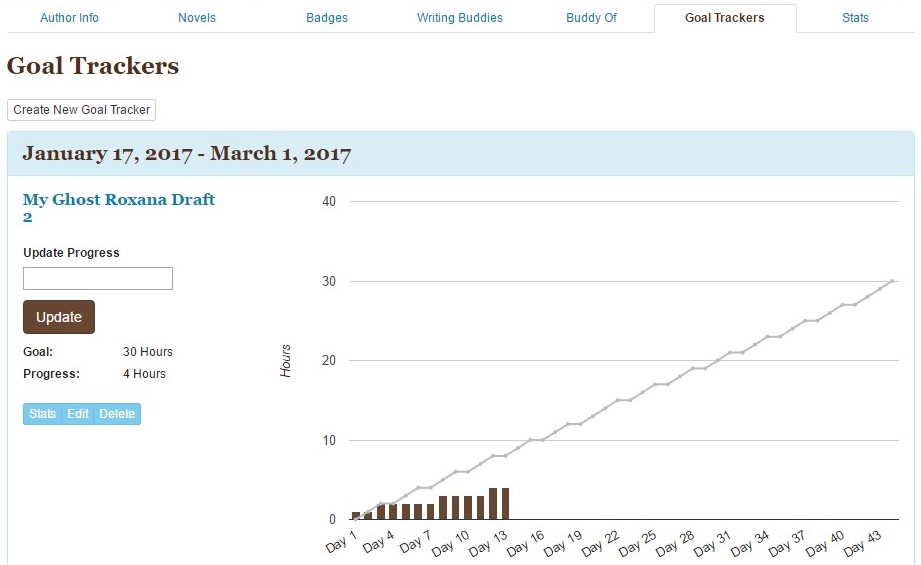
I'm back in the writing game thanks to this simple feature of the Nanowrimo website that allows me to set a writing goal and track my progress--outside of November! I've wanted this function for years, and I am pleased with its customizable elements. I chose to track my writing hours as I revise (since word count during revision fluctuates significantly), and even though I am currently behind in my hours, I like what I see.

2. An old love, Star Trek: Voyager
I came to the Voyager game way late, but better late than never. As a child, I watched Next Generation occasionally, but I really got the Star Trek spin-offs when I discovered them on Netflix. Voyager is by far my favorite spin-off: a female captain with quirks and flaws, a crew of diverse ethnicities and alien races, a dramatic tale of being lost in space--this show has it all!
2a. Some favorite episodes: Season 3.25 "Worst Case Scenario," Season 2.21 "Deadlock," and Season 4.18 & 4.19 "The Killing Game, Parts 1 and 2"

3. A new love, One Day at a Time
This Netflix sitcom is about family, and I am a sucker for shows about family. I am also a sucker for shows that provide insight into a different demographic. In this case, Cuban-Americans play on center stage, allowing me to consider what I have in common with them and what their unique strengths and struggles are. Plus, Rita Moreno. What more could I want?

4. Community Involvement a la Parks and Rec
I recently finished rewatching Parks and Recreation for the hundredth time (or so), and Leslie Knope always gets me fired up to be more involved in my community. Also, certain current events are getting me fired to be more involved in local government. So, I am now a volunteer at the Orem Public Library. I had to visit the Orem Police Department and City Center for the first time in order to apply for the volunteer position, and it was neat to walk past the City Council chambers and see the Orem seal lit up in a dark room. Anyway, I repair books so that (1) the city can save money on replacing books and (2) the children of my community can read and learn and grow. Plus, I get to be around books more. 5 out of 5 stars, would recommend.

5. Roasted Baby Carrots
I don't like raw carrots. Ever since I was a baby, I have had an odd reaction to something in carrots. It's almost like eating extremely sour food. HOWEVER. I discovered this month that I enjoy roasted baby carrots. It would probably be regular carrots, too, but I am too lazy to chop them up into bite-size chunks. Baby carrots come in smaller quantities and smaller chunks. Just sprinkle some salt, onion powder, and garlic over them and pop them into the oven for about 30 minutes. Delicious!

6. Mary Poppins musical
BYU put on a production of the Mary Poppins musical, which I saw in 2010 on the Broadway tour in Atlanta. I loved it the first time, partly because of the special effects: people and kites fly, and a certain chimney sweep tap dances on the ceiling. I thought BYU would not have the means to incorporate that level of effect, but I was wrong. They did a great job! Also, "Feed the Birds" always makes me cry. Also also, I want to be as confident as Mary Poppins when I grow up. After all, the song "Practically Perfect" is her singing about how perfect she is, "so people say."

Tuesday, January 10, 2017

Gordon B. Hinckley

I'm a little excited about the Relief Society manual for 2017. It features a certain adorable President Hinckley.

This is one of the most adorable pictures of him and Sister Hinckley.

In preparation to learn more from him and about him, I'm drawing on all my mind powers to remember him. He was the prophet of my youth, and he left a distinct impression on my life.

I remember when he challenged all members to read the Book of Mormon. We read it as a family and I was asked to speak about the experience in church. I recall feeling guilty for not reading it on my own, but looking back, there was nothing wrong (and likely many things right) with reading the Book of Mormon in a family setting.

I remember the 6 Bs: be smart, be clean, be true, be prayerful, be grateful, be humble. I also remember that he later added 3 more Bs: be positive, be still, be involved.

I remember when he dedicated the Salt Lake Conference Center and how the pulpit was built from a walnut tree that he planted.

I remember when he waved his cane at general conference.


I remember that he focused on building temples all over the earth.

I remember when he issued the Proclamation on the Family and the Living Christ.

I remember when he was on 60 Minutes.

I remember that he was confident that everything would work out.

And I remember when he died. I know exactly where I was and how I found out. I was sitting on the stairs at ward prayer during my freshman year and a friend announced it to the ward. My roommate burst into tears. Two days earlier, my Living Prophets class had finished our unit on President Hinckley. It felt like I had finally gotten to know him, and then he left.

Well, he's back in a way, and I look forward to learning even more about him this year. Miss you, President Hinckley!

Sunday, September 25, 2016

Sunday Thoughts: Power

I was promised in a blessing that I would find power in reading the scriptures. So, when my ward started a Book of Mormon reading program this month, I decided to take that promise literally and look for the word "power" and evidences of God's power. Here are some things I have learned so far about power.


  1. The Book of Mormon talks about God's power A LOT. Rather than just thinking of this book as "another testament of Jesus Christ," I'm starting to call it "another testament of Jesus Christ's power." Most chapters mention the word "power" at least once; some chapters bring it up several times. So far, all chapters provide evidence of the power of God as it works in the lives of the Nephites and Lamanites.
  2. God does not hesitate to use His power. Instead, we are the ones who hesitate. It was Laman and Lemuel who doubted and hesitated in the face of Laban's so-called power. Nephi knew and testified that God could overpower Laban. But even then, when bold Nephi was asked by God to kill Laban, Nephi hesitated. The Spirit reminded him of his testimony that God could do all things, even through a mere human like Nephi. This truth makes me wonder what blessings I am missing out on because I hesitate in my faith.
  3. Preparation for power has also come up a lot in 1 Nephi. Think of the 1 Nephi 3:7, where Nephi testifies that God prepares the way for us to use His power and obey His commandments. That verse is only the tip of the preparation iceberg. Therefore, I ask myself: what is God preparing me to do? How will I need to use His power?
  4. The Godhead are not the only beings with power. Today I read 2 Nephi 2, where Lehi describes the fall of Satan and the power that Satan wields. Of course, Satan's power cannot match God's, but we do need to be vigilant and rely on God's power in order to overcome the power that Satan uses against us.
As I continue through my readings, I will add more lessons about power. The more I think about it, the more I realize that I need the power of God daily. I'm sure the Book of Mormon will teach me ways to access that power and what it means to use it.